
The Man on the Rope
Everyone Has an Opinion Until They Step Onto the Rope
Why leadership under pressure demands steadiness more than applause
Mar 24, 2026
During the dark and uncertain days of the American Civil War, Abraham Lincoln found himself surrounded—not by enemies alone, but by voices. They came from every direction. Politicians pressed him, newspapers criticized him, advisors questioned him, and citizens, each with their own fears and convictions, demanded that he act more boldly, more cautiously, more quickly, more decisively. Everyone seemed certain. Everyone seemed urgent. And yet, the burden of decision rested on him alone.
Rather than answer his critics with argument, Lincoln offered them a story.
Thanks for reading! Subscribe for free to receive new posts and support my work.
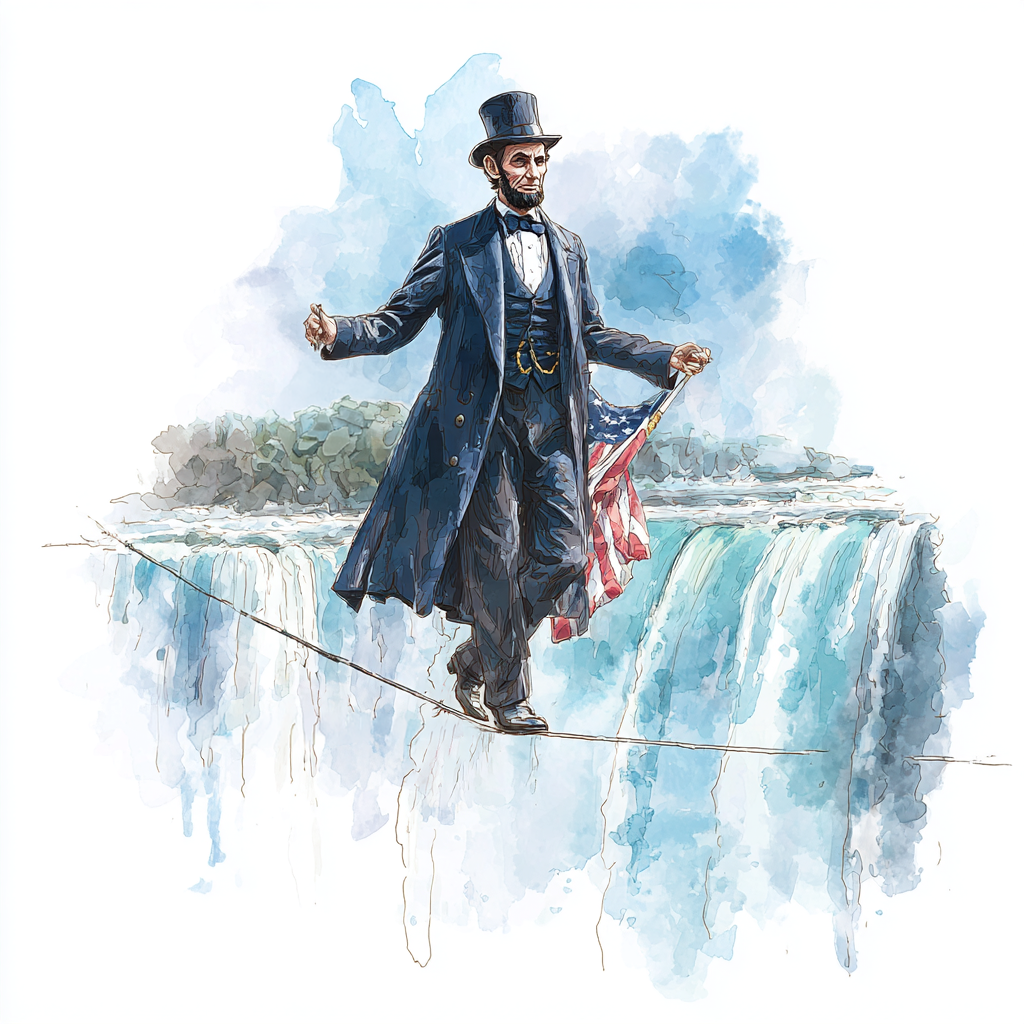
He spoke of Charles Blondin, the famed performer who drew crowds from miles around to witness his astonishing crossings over Niagara Falls. Suspended high above the roaring waters, Blondin would step onto a narrow rope and make his way across with remarkable calm. He did not simply cross once, but many times—blindfolded, pushing a wheelbarrow, even carrying another man upon his back. The crowds marveled. They cheered. They believed in him, at least while their feet were planted firmly on solid ground.
Then came the question that silenced them.
Blondin asked if they believed he could carry a man across on his back. The answer came quickly and confidently—yes, of course he could. But when he invited a volunteer, no one moved. The cheers faded into stillness. Belief, it turned out, is far easier at a distance than it is when one must step onto the rope.
Lincoln then invited his critics to consider something deeper. Suppose everything they owned, their fortunes, their futures, and their very security, rested in that wheelbarrow, and Blondin was already halfway across. Would they shout instructions? Would they call out for him to lean one way or the other, to hasten his steps or slow them? Or would they recognize, perhaps for the first time, that the man on the rope understood something they did not? Only he understood the feel of the wind, the sway beneath his feet, the weight he carried, and the consequence of even the slightest misstep.
The lesson was not lost on those who heard him. And it has not been lost on history.
Leadership at its highest level is not lived on firm ground. It is lived in that narrow and precarious middle. It is easy to form opinions from a distance. It is easy to see what appears obvious when one is removed from consequence. But the closer one comes to the rope, the more complex everything becomes. Balance replaces certainty. Timing replaces impulse. And the weight of each decision presses more heavily than those on the ground can fully comprehend.
That reality has not changed.
In our own time, the rope stretches across challenges that are no less demanding. Questions of law and order, of who belongs in our country and under what conditions, of how a nation protects its integrity while preserving its humanity; these are not theoretical debates. To the leader who must decide, they are living tensions, each step requiring judgment that accounts for both principle and consequence. Efforts to remove those who stand outside legal boundaries are met with both approval and resistance. Attempts to uncover fraud and root out corruption bring both confidence and concern. And beyond our borders, the management of rising threats carries implications that extend far beyond what can be seen in a single moment.
From the ground, voices rise quickly. Some insist that action is overdue, that strength must be demonstrated without hesitation. Others warn that such actions risk overreach, that caution must prevail. Still others shift between the two, responding not to the whole, but to the part they feel most deeply. Each voice carries conviction. Yet none carry the full weight.
There is a kind of illusion that comes with distance. It gives the impression of clarity without requiring the burden of responsibility. It allows for strong opinions without the necessity of consequence. But leadership does not permit such luxury. The one on the rope must carry all of the legal complexity, the human cost, the strategic risk, the timing of each decision, and the knowledge that every step shapes the next.
Lincoln understood that not all voices were equal. He did not close his ears to counsel, but neither did he surrender his balance to the noise. He learned, as all great leaders must, that there is a difference between those who seek to steady the rope and those who, however passionately, only add to its sway.
The danger is not criticism itself. Criticism can refine, sharpen, and even protect. The danger lies in the impulse to answer every voice, to adjust with every shout, to move not by judgment but by reaction. For once that begins, the rhythm is lost. The steadiness falters. And what was once a deliberate crossing becomes a struggle to remain upright.
What the crowd rarely perceives is the accumulation of weight. Each decision is not isolated. To enforce without compassion risks fracture. To show compassion without structure invites disorder. To expose corruption strengthens trust yet often reveals how deeply the problem runs. To act with strength may deter yet can also provoke. These are not simple choices between right and wrong. They are tensions that must be carried together.
And so the question Lincoln left behind continues to echo today.
Who, in any given moment, is truly on the rope?
And for those who are not, there is a quieter, more searching question still:
Are we offering balance… or are we adding sway?
The rope has never been easy to walk. The wind still rises. The weight still shifts. The voices still call out from every side. But progress has never belonged to those who shout the loudest from the ground. It belongs to those who, with steady step and measured judgment, continue forward—carrying more than most of us will ever fully understand.
About The Author

Leave A Comment