
read more posts by
kent@mrdirect.com

Meet Tzar Peter 1st of Russia
I credit my brilliant wife for this current deep dive into 17th century Russian history. She somehow found Peter the Great lurking in some rabbit hole she got sucked into and found it so interesting she made me crawl through it with her. Well, of course I saw it through the lens of a Leaderchip Cookie. So, bear with me.
There is a quiet but dangerous assumption that often slips into leadership. It is the idea that once we are given responsibility, that somehow equals preparation. History teaches something very different, and few lives illustrate it more clearly than that of Peter the Great, the ten-year-old Tzar of Russia.
Peter the Great was born in 1672 into the royal court of Russia, but there was nothing simple about his path to leadership. After his father died, the throne passed to his older half-brother, and when that brother died, things unraveled quickly. Rival family factions started fighting for control, and Peter, still just a boy, found himself right in the middle of it.
It turned violent in the Moscow Uprising of 1682, when palace guards revolted and blood was spilled inside the Kremlin. In the end, Peter was named co-tsar alongside his half-brother Ivan, with their sister Sophia really running things. He was about ten years old. He had the title, but no real control. What he did have was a front-row seat to how fragile leadership really is. That seems to have stuck with him. Somewhere in those early years, he figured out that if he was ever going to truly lead, he was going to have to get ready for it.
Any study of history demonstrates that few new kings have the capacity or maturity to lead a kingdom. Mostly they’re concerned with procreating to find an heir…I think you get what I mean.
What Peter did, however, still stands as one of the most remarkable acts of preparation in leadership history. So instead of pretending he knew what he was doing, he did something almost no one in his position would do. He left Russia.
In 1697, he headed out on what we now call the Grand Embassy, traveling across Europe not as a king looking for attention, but as a student trying to learn. He kept a low profile when he could. (He was tall, so his efforts at invisibility mostly failed.) He worked with his hands, and spent his time asking questions instead of giving orders. He went looking for people who actually knew how things worked.
In the Dutch Republic, he didn’t just tour shipyards, he worked in them. He learned how ships were built from the ground up. Not in theory, but in practice. How the keel was laid, how the ribs were shaped, how everything had to fit together so the ship could survive open water. He was out there doing the work because he knew that someday Russia would need a navy, and if he didn’t understand it, he couldn’t build it.
Then he went to England, where he spent time in the dockyards along the Thames. There he took it further. He studied full warships, how they were armed, how they were supplied, how they were maintained over time. He looked at rope-making operations, cannon foundries, navigation tools. He started connecting the dots. A navy wasn’t just ships. It was systems, industry, people, and precision all working together.
From there, he spent time in Prussia, focusing on the military. What he saw there was discipline and structure that Russia simply didn’t have. Soldiers trained the same way. Officers gave clear commands. Units moved with coordination. It wasn’t chaos. It was organized strength. He paid attention to how it all worked because he knew Russia would need that kind of order if it was going to stand against stronger nations.
When he came back home, he came back ready to act on what he understood.
He started building a navy. He reorganized the army. He brought in experts from across Europe to help train his people. He pushed into industry and education because he had seen firsthand how important they were. And when he founded Saint Petersburg, it wasn’t just about building a city. It was about opening Russia up and pointing it in a completely new direction.
What stands out to me in all of this is dang simple. He didn’t assume he was ready. He made himself ready.
He went and learned what he didn’t know. He surrounded himself with people who could teach him something. He prepared as he went, step by step, building real capability.
That’s the part that hits home.
It’s easy to step into responsibility and just start reacting. It’s harder to step back and ask, “Do I actually understand what I’m trying to lead?” Peter asked that question early, and he did something about it.
Leadership demands that kind of preparation. The kind you only get when you’re willing to be taught, willing to put in the time, and willing to admit you don’t have it all figured out yet.
Peter the Great became a great leader because he decided to prepare before it mattered most.
There is something deeply instructive in that choice. Peter dumped assumption or theory. He prepared himself by gaining real understanding. He treated leadership as a discipline that required study. (Of course I love him for that.) He knew that if he was going to build a navy, he needed to understand ships. If he was going to strengthen his military, he needed to understand how effective armies functioned. If he was going to expand industry and education, he needed to see how those systems worked where they were already successful.
Now might be the time for your own Grand Embassy.
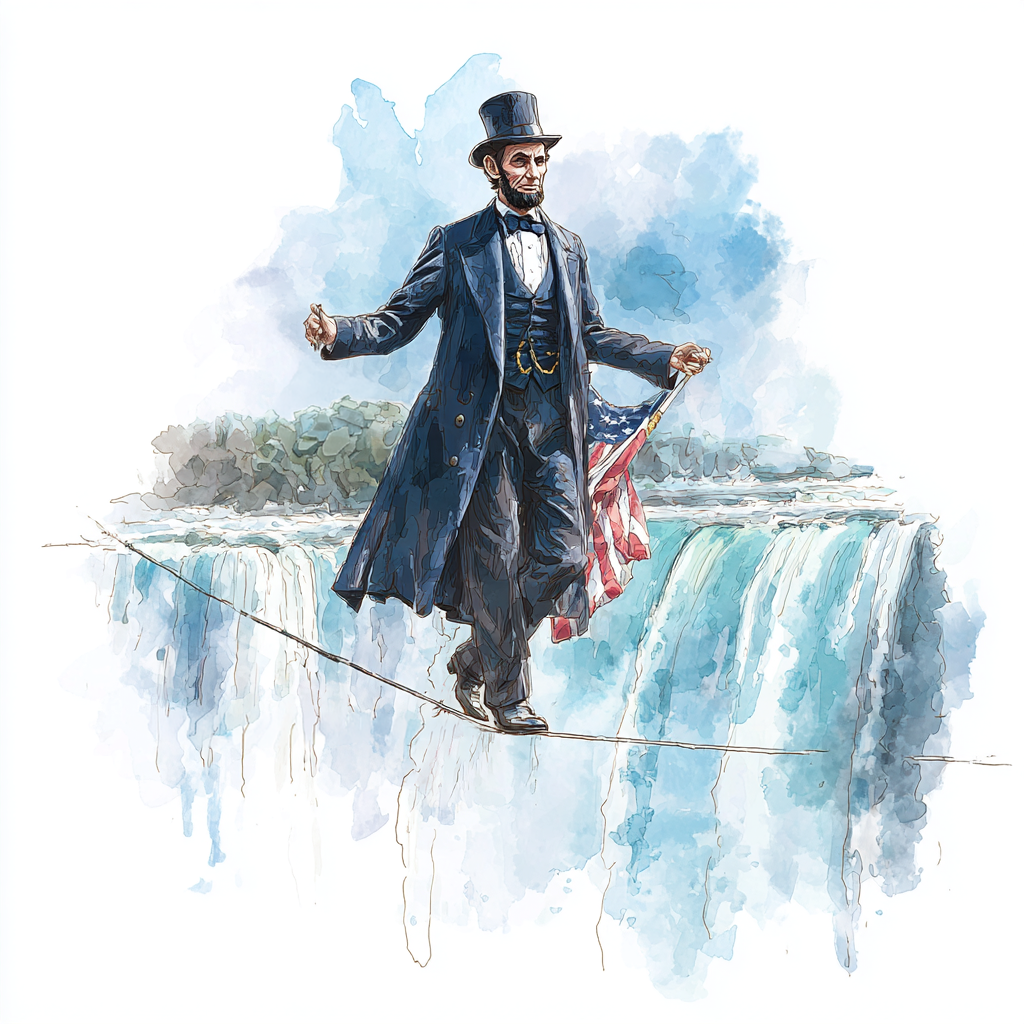
Everyone Has an Opinion Until They Step Onto the Rope
Why leadership under pressure demands steadiness more than applause
Mar 24, 2026
During the dark and uncertain days of the American Civil War, Abraham Lincoln found himself surrounded—not by enemies alone, but by voices. They came from every direction. Politicians pressed him, newspapers criticized him, advisors questioned him, and citizens, each with their own fears and convictions, demanded that he act more boldly, more cautiously, more quickly, more decisively. Everyone seemed certain. Everyone seemed urgent. And yet, the burden of decision rested on him alone.
Rather than answer his critics with argument, Lincoln offered them a story.
Thanks for reading! Subscribe for free to receive new posts and support my work.
He spoke of Charles Blondin, the famed performer who drew crowds from miles around to witness his astonishing crossings over Niagara Falls. Suspended high above the roaring waters, Blondin would step onto a narrow rope and make his way across with remarkable calm. He did not simply cross once, but many times—blindfolded, pushing a wheelbarrow, even carrying another man upon his back. The crowds marveled. They cheered. They believed in him, at least while their feet were planted firmly on solid ground.
Then came the question that silenced them.
Blondin asked if they believed he could carry a man across on his back. The answer came quickly and confidently—yes, of course he could. But when he invited a volunteer, no one moved. The cheers faded into stillness. Belief, it turned out, is far easier at a distance than it is when one must step onto the rope.
Lincoln then invited his critics to consider something deeper. Suppose everything they owned, their fortunes, their futures, and their very security, rested in that wheelbarrow, and Blondin was already halfway across. Would they shout instructions? Would they call out for him to lean one way or the other, to hasten his steps or slow them? Or would they recognize, perhaps for the first time, that the man on the rope understood something they did not? Only he understood the feel of the wind, the sway beneath his feet, the weight he carried, and the consequence of even the slightest misstep.
The lesson was not lost on those who heard him. And it has not been lost on history.
Leadership at its highest level is not lived on firm ground. It is lived in that narrow and precarious middle. It is easy to form opinions from a distance. It is easy to see what appears obvious when one is removed from consequence. But the closer one comes to the rope, the more complex everything becomes. Balance replaces certainty. Timing replaces impulse. And the weight of each decision presses more heavily than those on the ground can fully comprehend.
That reality has not changed.
In our own time, the rope stretches across challenges that are no less demanding. Questions of law and order, of who belongs in our country and under what conditions, of how a nation protects its integrity while preserving its humanity; these are not theoretical debates. To the leader who must decide, they are living tensions, each step requiring judgment that accounts for both principle and consequence. Efforts to remove those who stand outside legal boundaries are met with both approval and resistance. Attempts to uncover fraud and root out corruption bring both confidence and concern. And beyond our borders, the management of rising threats carries implications that extend far beyond what can be seen in a single moment.
From the ground, voices rise quickly. Some insist that action is overdue, that strength must be demonstrated without hesitation. Others warn that such actions risk overreach, that caution must prevail. Still others shift between the two, responding not to the whole, but to the part they feel most deeply. Each voice carries conviction. Yet none carry the full weight.
There is a kind of illusion that comes with distance. It gives the impression of clarity without requiring the burden of responsibility. It allows for strong opinions without the necessity of consequence. But leadership does not permit such luxury. The one on the rope must carry all of the legal complexity, the human cost, the strategic risk, the timing of each decision, and the knowledge that every step shapes the next.
Lincoln understood that not all voices were equal. He did not close his ears to counsel, but neither did he surrender his balance to the noise. He learned, as all great leaders must, that there is a difference between those who seek to steady the rope and those who, however passionately, only add to its sway.
The danger is not criticism itself. Criticism can refine, sharpen, and even protect. The danger lies in the impulse to answer every voice, to adjust with every shout, to move not by judgment but by reaction. For once that begins, the rhythm is lost. The steadiness falters. And what was once a deliberate crossing becomes a struggle to remain upright.
What the crowd rarely perceives is the accumulation of weight. Each decision is not isolated. To enforce without compassion risks fracture. To show compassion without structure invites disorder. To expose corruption strengthens trust yet often reveals how deeply the problem runs. To act with strength may deter yet can also provoke. These are not simple choices between right and wrong. They are tensions that must be carried together.
And so the question Lincoln left behind continues to echo today.
Who, in any given moment, is truly on the rope?
And for those who are not, there is a quieter, more searching question still:
Are we offering balance… or are we adding sway?
The rope has never been easy to walk. The wind still rises. The weight still shifts. The voices still call out from every side. But progress has never belonged to those who shout the loudest from the ground. It belongs to those who, with steady step and measured judgment, continue forward—carrying more than most of us will ever fully understand.
Introduction to the General Theory of Leadership
Laws come in many forms. One type stems from legislative enactment—arbitrary rules and regulations designed to govern human behavior. These laws, often enforced by courts and their agents, may be just or unjust, beneficial or harmful. They can arise from whim, compromise, custom, precedent, justice, or force, and they can be repealed in the same manner. We will call these the “laws of the land.” Subject to the will, whimsy, or passion of those with enforcement power, they may be ignored, suspended, or altered at any time.
In contrast, there exists another set of laws: natural laws, or the laws of nature. These remain constant and unchangeable under all circumstances. Humans did not create them, nor can we bend them to our will. Their verdicts are final, offering no room for appeal. While they can sometimes cause harm, they are at least predictable—unaffected by mood or caprice. They are always reasonable, always dependable. When we align ourselves with these laws, we can expect consistent results.
Consider a simple example. My wife gathers a handful of ingredients from the refrigerator, pantry, and cupboard. Within minutes, she transforms them into a delicious, aromatic dish straight from the oven, and we enjoy a magnificent meal together. Her consistency is remarkable. How does she do it? How does anyone?
She understands the laws of the kitchen. If you’ve ever succeeded in the kitchen, you’ve relied on these same laws.
Here are a few:
Water boils at 212°F.
Water freezes at 32°F.
Egg proteins transform when heated or beaten, binding diverse ingredients together.
Baking powder and baking soda release carbon dioxide through acidic and alkaline reactions, inflating delicate baked goods.
Yeast, a living single-cell fungus, feeds on flour’s sugars, producing carbon dioxide to make bread rise.
Controlled growth of microorganisms enables the creation of pickles, bread, yogurt, wine, beer, and cheese.
Searing meat between 300°F and 500°F on a grill or in an oven, combines amino acids and sugars, giving it color, aroma, and a rich, “meaty” flavor.
Time and temperature shape flavors, textures, and aromas.
Fatty ingredients like butter or non-sucrose sugars like corn syrup prevent sugar crystals from ruining candy textures.
Almost any kitchen mistake can be salvaged with ice cream, ketchup, or bacon.
In essence, she knows precisely what happens when she combines ingredients and applies heat, cold, or time. Imagine the chaos if water boiled or froze at random temperatures, or if flour sometimes refused to dissolve in milk. Her success hinges on the unyielding dependability of these natural laws—what I call the “laws of the kitchen.” Whether violated by an eager novice, a master chef, or my wife, these laws remain unforgiving. Believe me, there are times when she wishes something would freeze faster or cook sooner, but she cannot alter their course.
Great culinary schools train aspiring chefs in these same principles. Every lesson, every recipe, adheres to the laws my wife follows. No chef succeeds without strict obedience to them. A wise cook learns to understand these laws, trusting their predictable outcomes to achieve consistent results.
The Laws of Leadership
Similarly, there exists another set of laws just as reliable: the laws of leadership. Rooted in human nature, these laws are as unfailing as those of the kitchen. When understood and applied, they unlock extraordinary possibilities. When we ignore the laws of the kitchen, the consequences can be trivial—wasted time and ingredients, easily remedied with a bowl of cereal. But when we fail to grasp the laws of human nature, the stakes rise. Missteps here can lead to serious, even devastating, consequences that may take years to mend.
Yet, by mastering the laws governing our own lives, we can achieve profound transformations. The laws of leadership offer us unparalleled opportunities. It is our responsibility to learn them and wield them effectively.
Leadership, when exercised by good and honorable people, is the most potent moral force on earth. It is the taproot of civil society, the heartbeat of democracy, and the foundation of thriving free enterprise, government, communities, churches, and families. Leading may be the most intricate and creative of human endeavors, an art form of unparalleled elegance.
No two acts of leadership—whether simple or monumental—are identical. Each emerges uniquely from real lives, personalities, cultures, situations, and dreams. While products can consistently roll off assembly lines and as we watch, engineers can design rockets to circle the earth and return safely to their launching pads. Yet, leadership resists formulaic precision. Why? Because it requires a human being.
Leadership cannot be inherited, bestowed, or handed down through succession. It arises when someone steps forward with initiative—be it a simple idea or a grand vision—and others choose to follow. Together, they advance toward results.
When we truly understand leadership and human behavior, we become better equipped to identify, educate, coach, and nurture future leaders. These leaders, in turn, can wield good and honorable influence with greater power among those they serve. Developing such leaders is an urgent need for every society, institution, and enterprise. Where honorable leadership falters or fades, brute force, blind ambition, selfishness, deception, hatred, sensuality, terrorism, war, and violence take root—chronicled throughout history as human devastation.
So, what can we do? The journey begins here. Follow the next thirty delicious chapters as we explore the doctrines, realities, and principles of leadership. Together, we’ll uncover the laws that govern this vital art and learn how to apply them for the good of all. As a bonus we’ll share some of the greatest cookie recipes we can plunder from the secret recipe stash. But we will start with the most famous recipe of them all. Yes. The Toll-House Cookie.
On our way to the recipe, let’s give some honor where it’s due.
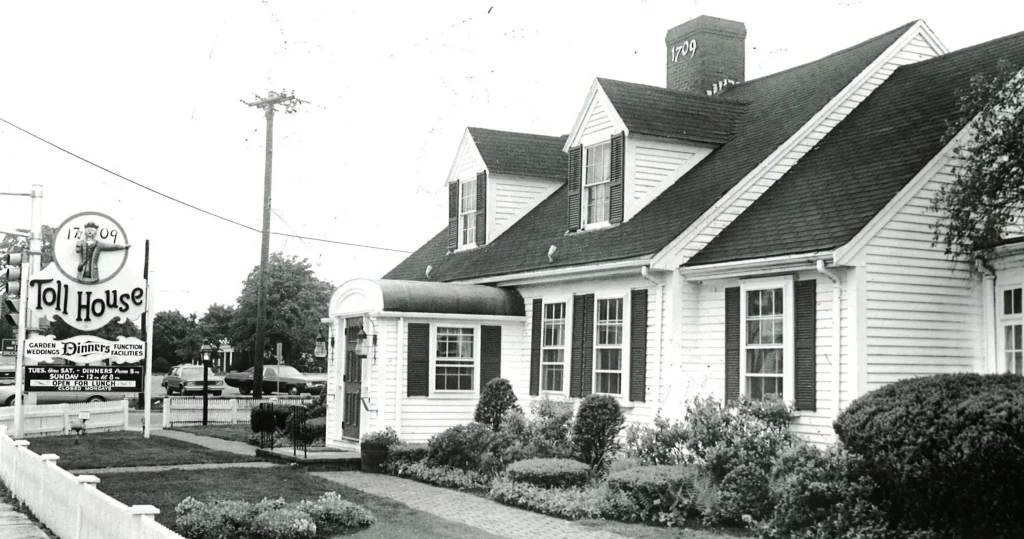
Ruth Graves Wakefield’s life offers enough documented detail to discuss her leadership skills and experience, though much of what we know comes from biographical snippets, her own writings, and historical accounts rather than a deep, personal archive of her leadership philosophy. As the inventor of the chocolate chip cookie and co-owner of the Toll House Inn, her story reveals traits and actions that align with effective leadership—particularly in entrepreneurship, innovation, and community influence.
Ruth was born in East Walpole, Massachusetts, in 1903. She graduated from Framingham State Normal School (now a university) in 1924 with a degree in household arts. Since she trained as a dietitian and home economist, she gained skills that shaped her practical approach to life. She became a lecturer on food preparation, teaching others how to cook and manage kitchens. I’m calling that leadership in education and mentorship.
She married Kenneth Wakefield in 1926 and they built a business together, suggesting a strong partnership dynamic. They bought the Toll House Inn in Whitman, Massachusetts. Ruth was a culinary mastermind managing the kitchen and menu, and Kenneth handled the front-of-house operations.
Ruth transformed the inn into a dining destination known for quality home-cooked meals. Ruth Wakefield, a skilled cook and dietitian, ran the Toll House Inn in Whitman, Massachusetts, with her husband in the 1930s. Known for her delicious homemade desserts, she was always tinkering with recipes to delight her guests. One day in 1937, while baking a batch of butter cookies, she mixed things up. She grabbed a bar of Nestlé semi-sweet chocolate, expecting it to melt into the dough for a chocolaty flavor. Instead, she chopped it into small chunks and tossed them in, hoping they’d spread evenly.
When she pulled the tray from the oven, the chocolate hadn’t melted as expected—it stayed in distinct, gooey bits, creating a delightful contrast with the soft, buttery cookie. Her guests loved them, and the “chocolate crunch cookies,” as she first called them, became a hit. Word spread fast, and soon Nestlé noticed the buzz. Ruth struck a deal with the company: they could print her recipe on their chocolate bars, and she’d get a lifetime supply of chocolate. By 1939, Nestlé was selling pre-chopped chocolate chips, and the Toll House Cookie was born.
The invention wasn’t a grand plan—just a curious cook experimenting in her kitchen, stumbling onto something timeless. Today, chocolate chip cookies are a global staple. But before jumping to the recipe, which if you are a true human being, you already have in your collection of recipies; indulge my extrapolation of Ruth’s leadership.
Her invention of the chocolate chip cookie wasn’t just a happy accident—it showed her willingness to experiment and adapt (chopping chocolate).
She published “Toll House Tried-and-True Recipes” (first edition 1937, expanded later), sharing over 700 recipes, including the famous cookie. This reflects a leader’s foresight—codifying her work to influence beyond her kitchen.
She showed resourcefulness and strategic planning by running a small inn during the Great Depression which required thrift and ingenuity. Ruth stretched ingredients and crafted a menu that balanced comfort with creativity, drawing travelers and locals alike.
She made a deal with Nestlé—allowing them to print her recipe on chocolate chip bags—shows strategic thinking. She traded short-term control for long-term impact, boosting both her cookie’s fame and the inn’s reputation.
Her educational background implies she trained others effectively, a key leadership skill—perhaps teaching staff her recipes or techniques.
Guests trusted Ruth’s cooking, returning for her signature dishes. Her cookie’s spread via word-of-mouth (and later soldiers’ letters in WWII) shows she inspired loyalty and enthusiasm without formal authority beyond her inn.
Sharing her recipe with Nestlé and the public (rather than patenting it) reflects a servant-leader mindset—prioritizing accessibility over personal gain.
Turning a chocolate shortage into a new cookie type shows creativity under pressure, a hallmark of adaptive leadership.
She didn’t just cook; she was a visionary; she built a brand (Toll House) and a legacy (the cookie), blending day-to-day management with a bigger picture.
She was collaborative yet decisive: Working with Kenneth and Nestlé suggests teamwork, but her kitchen domain shows she made firm calls where it mattered.
She was a community builder: Her inn fostered connection—travelers felt at home, and her recipe became a shared American tradition, showing quiet influence.
The rest of the story: Ruth sold the inn in 1966. We know very little about her post-Toll House years. We know she worked briefly as a hospital dietitian. She died in January 1977 in Plymouth, Massachusetts. Her husband died twenty years later in 1997. His post-Ruth life seems to have been private, with no notable public activities. Ruth’s son, Kenneth Jr. died in 1993 and it is thought that Kenneth spent his later years with their daughter, Mary Jane. She could probably whip up a pretty mean batch of cookies herself.
We know enough about Ruth to frame her as a practical, innovative leader in a small-business context—less about formal authority, more about influence through skill and vision. Her leadership shines in her ability to turn a simple inn into a culinary landmark and a single recipe into a global phenomenon, all without a title beyond “cook.” It’s a brilliant case study for students: leadership isn’t always loud—it can be baked into a cookie!